Understanding Ultimate Tensile Strength (UTS) of Mild Steel: A Complete Guide
March 05, 2026 By admin

Understanding Ultimate Tensile Strength (UTS) of Mild Steel: A Complete Guide
It is one of the most commonly used materials in construction, manufacturing, and engineering processes, given that it has the ideal strength, ductility, and low cost. One of its primary mechanical characteristics that characterizes the performance of the material is the Ultimate Tensile Strength (UTS). So what is UTS, and what is so important about UTS as an application in projects such as tensile structures, membrane structures, car park design, and new-age global tensile technology?
Here we shall deal with:
- The meaning of Ultimate Tensile Strength (UTS) of mild steel
- The effect UTS has on structural integrity across application areas
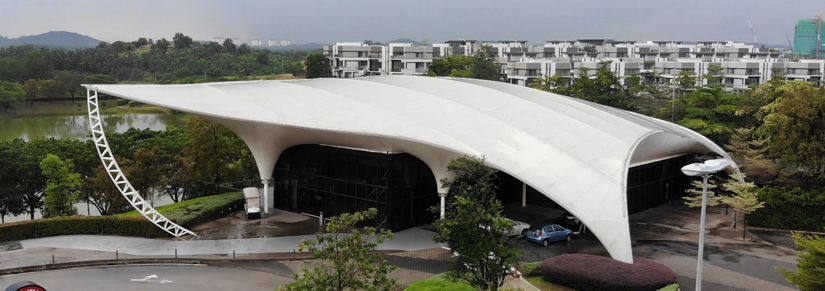
- The applications of mild steel to the tensile membrane structures, car parking systems, and tensile technologies systems in the world
- Techniques and industry trends
Ultimate Tensile Strength (UTS): What is it?
Ultimate Tensile Strength (UTS) is the greatest possible stress that can be laid on a material as it is stretched or pulled without rupturing. The UTS generally varies between 370 MPa and 500 MPa in the case of mild steel, depending on its composition and treatment.
Relevant Key Terms to UTS
- Yield Strength: It is used to denote the amount of stress that causes mild steel to start permanently deforming.
- Elastic Limit: The maximum stress to which a material may be subjected before the removal of the load causes permanent deformation.
- Breaking Strength: The Stress at which the material cracks.
Why UTS Plays a Role in Tensile Structures
Tensile structures (such as canopies, stadium roofs, and shade systems) depend on material that is able to resist great tension without breaking. The good UTS and ductility properties found in mild steel make it favorable to use in:
- Tensile membrane structure support schemes
- Anchoring structures that attach fabric or ETFE membranes
- Load-carrying suspension cables
Tensile Membrane Structures
- Material Selection: If the membrane is typically composed of PVC or PTFE, the supporting structure (masts, cables) is typically composed of mild steel due to its high ratio of UTS to cost.
- Load Distribution: The UTS will avoid exorbitant deformation of the steel parts to withstand wind and snow, as well as dynamic loads.
Tensile Car Parking Mild Steel
Tensile car parking structures and car parking shades are made of materials that can:
- Resist weathering and corrosion (frequently by galvanizing)
- Resist the vehicular and environmental dynamic loads
- Offer comfort over long periods without a lot of additional maintenance
What is so special about mild steel?
- Stability under tension is provided by high UTS.
- Economical as opposed to stainless or aluminum.
- Customization in designs can be done due to the ease of fabrication.
Global Tensile Technologies and Mild Steel Innovations
With the development of tensile architecture, tensile technologies all around the world are straining the possibilities of the materials used. Innovations include:
- Better UTS and corrosion resistance in mild steel, high-strength low alloy (HSLA).
- Mixed structures, which are made with both tough and lightweight designs, use carbon fiber materials with mild steel.
- Intelligent tensile systems that can monitor stress in real time with sensors.
Recent Blog